
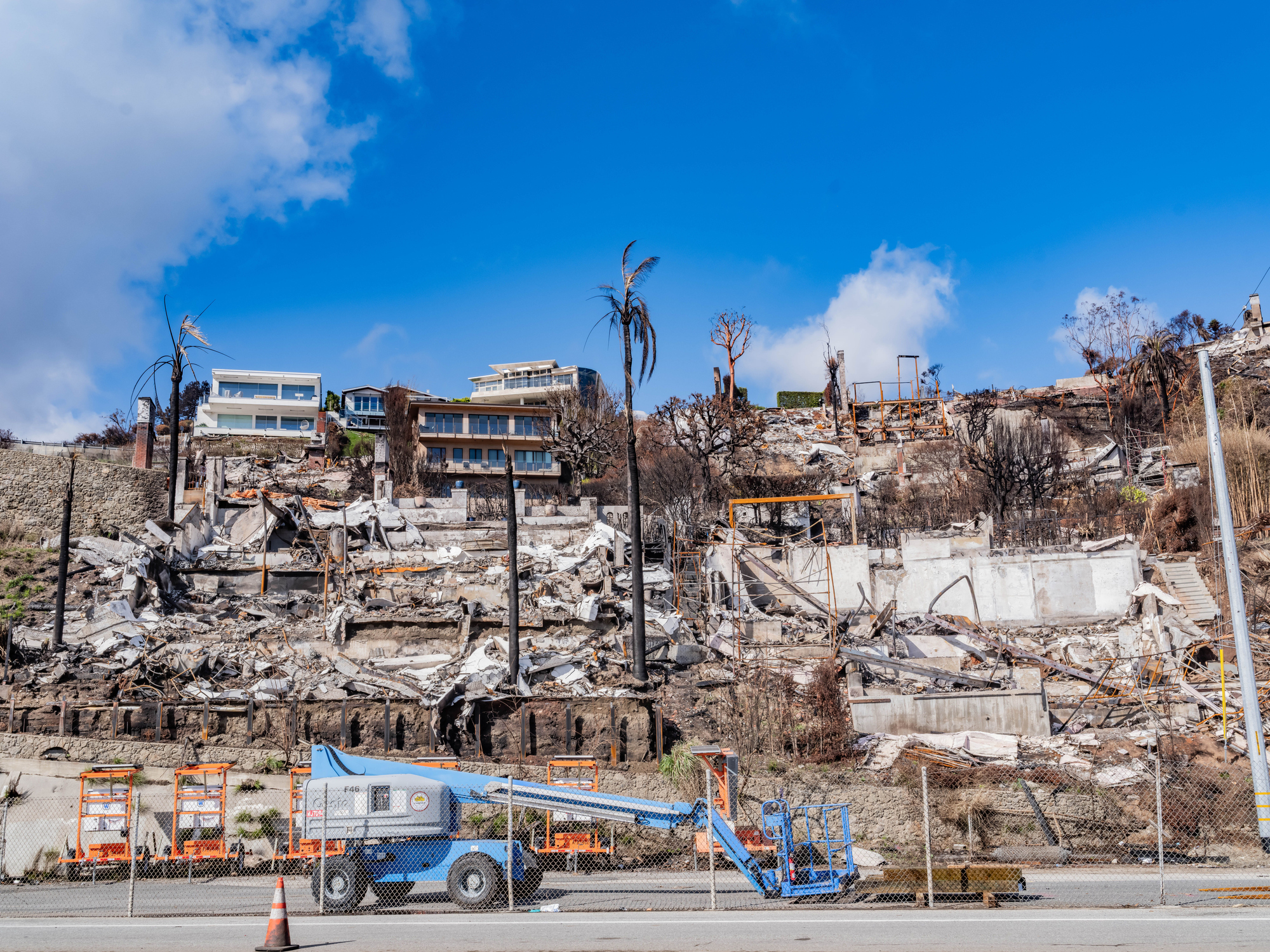
A comprehensive post-event investigation of the 2025 Palisades and Eaton Fires—the second and third most destructive fires in California’s history—reveals that no single mitigation strategy protects homes during intense urban conflagrations; instead, homes need multiple defensive layers working in coordination, according to research from the Insurance Institute for Business & Home Safety (IBHS).
Researchers surveyed more than 60 data points at individual parcels across fire-damaged communities in Los Angeles County and combined their findings with broader damage inspection data.
The investigation illuminates three interconnected factors that determine whether structures survive structure-to-structure fire spread: spacing between buildings, vegetation and fuel management around homes, and the materials used in construction.
Distance Matters, But Only to a Point
Structure spacing emerged as perhaps the most pivotal variable in preventing damage, according to the analysis.
Even homes with four fire-resistant building characteristics had less than a 50% chance of avoiding damage when the nearest neighbor was within 10 feet—a common scenario in dense suburban neighborhoods.
The research identified a critical threshold at 30 feet. Each additional 10 feet of separation increased the likelihood of no damage by 7 to 13%, but beyond 30 feet, this protective effect plateaued. At separations greater than 30 feet, the probability of no damage stabilized at approximately 66% for well-hardened structures and 51% for those with minimal hardening features.
Wind direction proved equally consequential as distance itself, IBHS said. Structures positioned downwind from burning neighbors experienced dramatically higher damage rates, particularly at greater separation distances. At separations exceeding 10 feet, downwind structures were 22% more likely to be damaged or destroyed than those positioned upwind or crosswind, regardless of building materials or fuel conditions.
The Hidden Threat of Connective Fuels
Nearly every structure investigated by IBHS had combustible materials within the immediate five feet surrounding homes—a zone known as Zone 0. This was the single most revealing finding about suburban vulnerability, the report said.
When Zone 0 fuel coverage remained below 25%, homes had a 58% chance of being damaged or destroyed. Once this threshold was exceeded, damage likelihood spiked to between 87 and 100%. The research also identified Zone 1—the area from 5 to 30 feet from the home—as increasingly important when Zone 0 was properly managed. Keeping Zone 1 fuel coverage below 25% reduced damage likelihood by about 24% compared to higher fuel densities.
Beyond vegetation, investigators discovered that everyday household items functioned as dangerous connective fuels. Trash bins, combustible decks, hot tubs, and pergolas positioned adjacent to building openings or vulnerable features created pathways for fire to breach structures. Vegetation growing along noncombustible fences negated the protective value of those materials, a pattern observed repeatedly across the burned areas.
The Need for Comprehensive Building Systems
Most surveyed structures included at least one resilient building component, such as noncombustible exterior cladding or Class A roof coverings. However, this piecemeal approach left critical vulnerabilities exposed.
Structures incorporating four home-hardening characteristics—representing an integrated defensive system—had a 54% likelihood of experiencing no damage even under severe conflagration conditions. By contrast, homes with only one or two hardening features had just a 36% probability of avoiding damage. A recurring weakness across nearly all surveyed structures was the absence of 1/8-inch mesh on roof vents, which allowed embers to penetrate interiors.
The research underscores that effective resilience requires combining hardened building components with strategic fuel management. When these elements work as a coordinated system, the probability of avoiding damage aligns more closely with the underlying physics of wildfire exposure.
“This study underscores a critical truth: in densely built communities like Los Angeles where we can’t change structure spacing, only a system of mitigations can keep wildfires from cascading into block-by-block destruction,” said Roy Wright, president and CEO of IBHS. “Home hardening and a noncombustible Zone 0 are essential to remove the weak links fire looks to exploit. When homeowners take these actions, we dramatically increase the chances that people can return to their homes after a fire. That’s hope grounded in science.”
Obtain the full report here.